
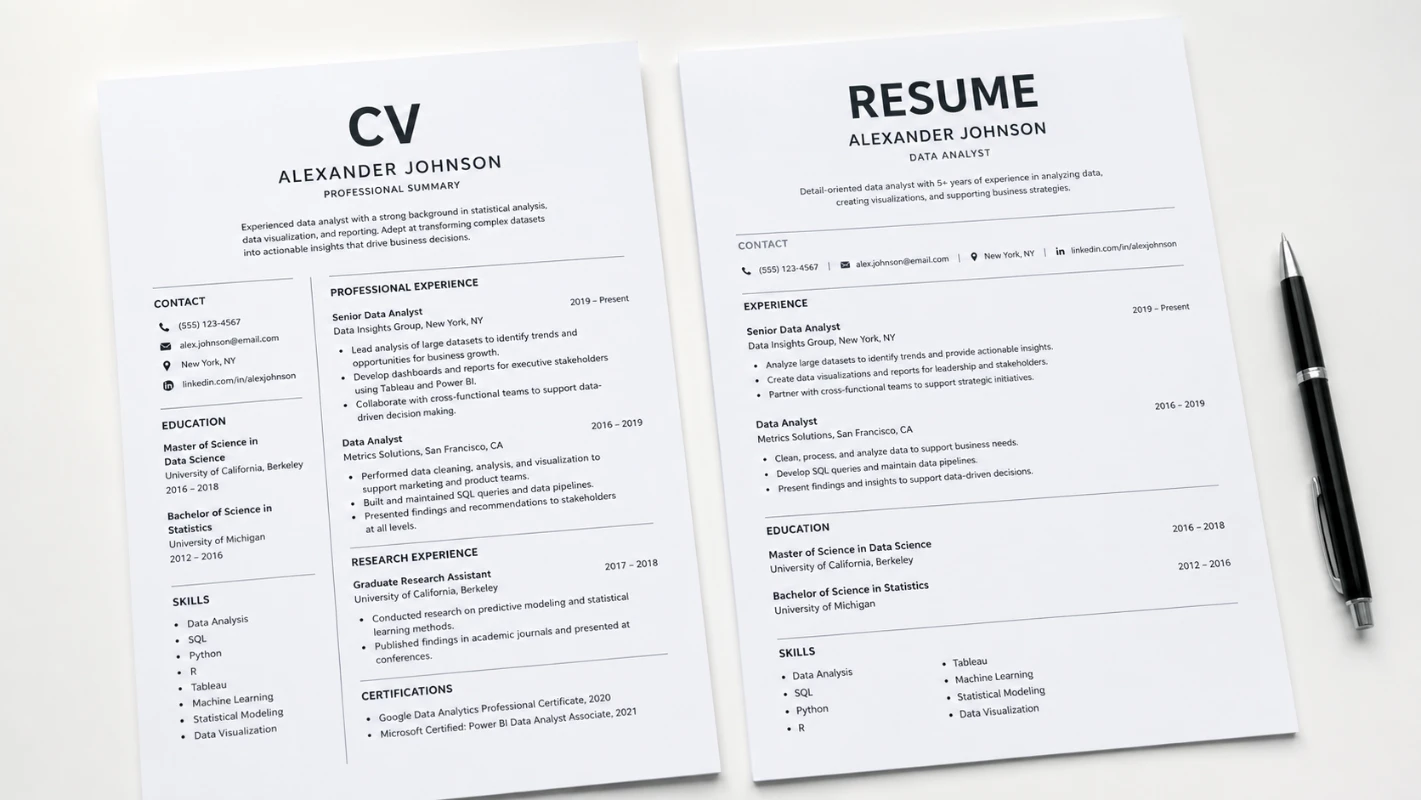
If you have ever wondered whether to send a CV or a resume — you are not alone. Most job seekers use both terms interchangeably without realising they can mean very different things depending on where you are applying and what kind of role you are targeting.
The short answer is that in most countries outside North America — including Pakistan, UAE, Saudi Arabia, UK, and Australia — CV is the standard term and the document you send to employers. In the United States and Canada, resume is the standard for most professional applications. But the full picture is more nuanced than that — and getting it wrong can quietly hurt your application.
This guide covers the key differences between a CV and a resume, when to use each, and what employers in different countries actually expect.
What Is a CV?
CV stands for curriculum vitae — a Latin phrase meaning "course of life." A CV is a comprehensive document that covers your complete professional and academic background. Unlike a resume, a CV has no strict page limit — it includes everything relevant to your career, and in some fields, particularly academia and research, it can run to many pages.
A standard professional CV includes:
- Personal information and contact details
- Professional summary or personal statement
- Work experience — in full detail
- Education — all qualifications
- Skills — technical and professional
- Certifications and training
- Languages
- References
In academic and research contexts, a CV also includes publications, conference presentations, research grants, teaching experience, and professional memberships — sections that would never appear on a standard resume.
What Is a Resume?
Resume comes from the French word meaning "summary." A resume is a concise, targeted document — typically one to two pages — that summarises your most relevant experience and skills for a specific job application.
Unlike a CV, a resume is deliberately edited for each application. You include only what is relevant to the specific role you are applying for. Experience from ten years ago that does not support your current application gets cut. The goal is brevity and relevance — not comprehensiveness.
A standard resume includes:
- Contact information
- Professional summary — 2 to 4 lines, tailored to the role
- Work experience — most relevant roles, focused on achievements
- Education — condensed
- Skills — relevant to the specific job
CV vs Resume — Key Differences at a Glance
| Feature | CV | Resume |
|---|---|---|
| Length | 2+ pages — no strict limit | 1 to 2 pages maximum |
| Purpose | Comprehensive life record | Targeted job application |
| Content | Complete history — everything relevant | Selected highlights — most relevant only |
| Tailoring | Generally consistent across applications | Customised for each application |
| Photo | Common in Gulf, Pakistan, Germany | Never in USA, Canada |
| Used in | UK, Pakistan, UAE, Gulf, Australia, Europe | USA, Canada primarily |
| Academic use | Includes publications, grants, research | No academic-specific sections |
Which Countries Use CV — and Which Use Resume?
This is where most of the confusion comes from. The same document gets called different things in different countries — even when the content is essentially the same.
Countries that use CV
Pakistan: CV is the universal term across all sectors — private, government, NGO, and corporate. When a Pakistani employer says "send your CV" they mean a formal 1.5 to 2 page document following Pakistani conventions including a photo and career objective.
UAE and Gulf Countries: CV is the standard term across the entire GCC region. Gulf employers expect a two-page CV with photo, nationality, visa status, and date of birth — all of which would be unusual on a UK or US document.
United Kingdom: CV is the standard term — and the document follows specific British conventions. No photo. No date of birth. Maximum two pages. Clean, achievement-focused content. When a UK employer says CV, they mean exactly this format.
Australia: Both CV and resume are used interchangeably — the document is the same either way. Australian conventions sit between UK and North American styles — two to three pages, no photo, references commonly included.
Europe: CV is standard across most European countries. Germany uses Lebenslauf — which is the German word for CV — with its own specific tabular format and photo conventions.
Countries that use Resume
United States: Resume is the standard term for virtually all professional job applications. American resumes are typically one page — occasionally two for senior candidates — and focus on quantified achievements. CVs in the US are reserved almost exclusively for academic, research, medical, and scientific positions.
Canada: Resume is more commonly used than CV for professional applications — following North American conventions. One to two pages. No photo. No date of birth. Work authorization status included if relevant.
Does the Content Actually Differ?
For most professional job seekers — not academics or researchers — the content of a CV and a resume is largely the same. The key differences are in length, tailoring, and what personal details are included.
A Pakistani CV vs a Canadian resume for the same candidate:
- Pakistani CV: two pages, photo, career objective, date of birth, nationality, references included — sent to multiple employers with minimal changes
- Canadian resume: one to two pages, no photo, professional summary tailored to each role, no personal characteristics, work authorization stated — customised for each application
The underlying experience is the same. The presentation, length, and personal details differ significantly based on where you are applying.
When Is a CV Used in the USA?
In the United States, the term CV is reserved for specific professional contexts — primarily in academia, research, medicine, and science. An American academic CV is a very different document from a standard professional CV — it can run to many pages and includes sections that would never appear on a professional resume:
- Publications — books, journal articles, research papers
- Conference presentations and keynote speeches
- Research grants and funding received
- Teaching experience — courses taught, departments, institutions
- Academic awards and honours
- Professional memberships and committee service
- Thesis and dissertation supervision
If you are applying for a university faculty position, a medical residency, a research fellowship, or a scientific role in the USA — you need an academic CV, not a resume. For every other professional role in America — you need a one to two page resume.
Which Should You Use for International Applications?
If you are applying for jobs in multiple countries simultaneously — which is increasingly common for skilled professionals from Pakistan, India, and other markets — the safest approach is:
- Keep a master CV — a comprehensive two-page document with all your experience and personal details following your home country conventions
- Create a tailored version for each target market — removing the photo and personal details for UK and North American applications, adjusting the length, and updating the personal summary
- Follow the job advertisement — if the ad says CV, send a CV. If it says resume, send a resume. Never overthink a simple instruction
CV and Resume Format by Country — Quick Reference
| Country | Term Used | Length | Photo | Personal Details |
|---|---|---|---|---|
| Pakistan | CV | 1.5 to 2 pages | Expected | DOB, nationality common |
| UAE / Gulf | CV | 2 pages | Expected | Nationality, visa status required |
| UK | CV | Max 2 pages | No photo | Minimal — city only |
| Australia | CV or Resume | 2 to 3 pages | No photo | City, work rights |
| Canada | Resume | 1 to 2 pages | No photo | City, work authorization |
| USA | Resume | 1 to 2 pages | Never | City only — nothing personal |
| Germany | Lebenslauf | 1 to 2 pages | Expected | DOB, nationality, address |
Build Your CV or Resume Free
Whatever format you need — our free CV builder produces a clean, professional document ready to send to employers in any country. Choose the template that suits your target market, fill in your details, and download a PDF in minutes.
No sign-up required. No watermarks. No payment.
Frequently Asked Questions
Is a CV the same as a resume?
In most countries — including Pakistan, UAE, UK, and Australia — CV and resume refer to the same document. The key differences emerge when comparing professional CVs used in these markets with academic CVs or North American resumes. For most professional job seekers, the terms are interchangeable — but the format and content should follow the conventions of the country you are applying in.
Which is better — a CV or a resume?
Neither is better — they serve different purposes in different markets. A CV is better for applications in Pakistan, UAE, UK, Gulf countries, and Europe. A resume is better for applications in the USA and Canada. The right choice depends entirely on where you are applying and what the employer expects.
Can I send a CV instead of a resume to US employers?
For most professional roles in the USA — no. American employers expect a one to two page resume, not a comprehensive CV. Sending a two-page CV with a photo and personal details to a US employer signals unfamiliarity with American hiring conventions. The exception is academic, research, and medical positions in the US where a full academic CV is expected and required.
How long should a CV be compared to a resume?
A professional CV is typically two pages — though it can be longer for very senior candidates or academic CVs which have no practical page limit. A resume is typically one to two pages — with one page being the strong preference for North American employers, particularly for candidates with fewer than ten years of experience.
Do I need different documents for different countries?
Yes — ideally. A document formatted for Pakistan or Gulf employers — with photo, date of birth, nationality, and two pages of detail — will not perform well with UK or North American employers. The safest approach is to maintain a master version and create tailored versions for each target market, adjusting photo, personal details, length, and professional summary accordingly.
Ready to build your CV?
Use our free CV builder — ATS-friendly templates, guided sections, and clean PDF download. No sign-up required.
Build Your CV Free →