
CV for Senior Professionals — How to Write an Experienced CV That Opens Doors
Writing a CV as a senior professional presents a different challenge from writing one earlier in your career. You have more experience than you can fit on two pages, more achievements than you can list in a dozen bullet points, and a career story that is genuinely impressive — but needs to be curated, not catalogued. The most common senior professional CV mistake is treating the document as a comprehensive record of everything you have ever done rather than a targeted case for why you are the right person for this specific next role.
This guide covers exactly how to write a CV for senior professionals — how to select and present your strongest experience, how to structure a document that commands immediate attention, and how to avoid the most common mistakes that prevent experienced candidates from getting the interviews their backgrounds deserve.
Build your CV using our free CV builder with professional templates designed for every career level.
What Makes a Senior Professional CV Different
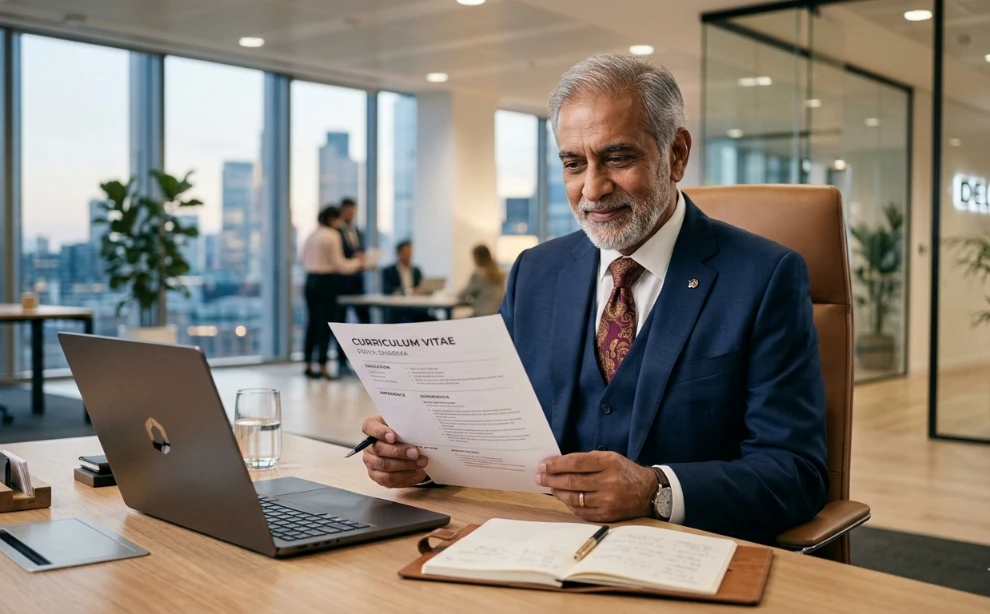
A CV for a senior professional is not simply a longer version of a mid-career CV. It operates by different rules — different priorities, different structure, and different expectations from the recruiters and hiring managers who read it.
Impact replaces activity. At senior level, no recruiter is interested in what your day-to-day responsibilities were. Every line of your CV should answer one question — what changed, improved, or grew because you were there? Revenue generated, costs reduced, teams built, processes transformed, organisations led through change — these are the credentials that matter at senior level.
Narrative matters as much as chronology. A standard CV lists roles in reverse date order and lets the recruiter piece together the picture. A strong senior professional CV tells a deliberate career story — one that positions your progression as a coherent arc of increasing responsibility, commercial impact, and strategic contribution.
Curation is more important than comprehensiveness. You have more experience than will fit well on two pages — which means every editorial decision matters. What you leave out is as important as what you include. A recruiter reading a senior CV expects to see the highlights of a distinguished career — not a complete record of every role and responsibility since graduation.
The most important mindset shift for senior professionals: your CV is a leadership document, not a job application document. It should read as a confident, authoritative account of a career that has consistently delivered at a high level — because that is exactly what it is.
What to Include in a Senior Professional CV
A strong senior professional CV covers these sections — each approached with a strategic and commercial lens:
Personal Information
Full name, professional title at your current seniority level, phone, email, city, and LinkedIn profile. Your professional title should reflect your actual level — Head of, Director, VP, Senior Manager, General Manager. Do not understate your seniority. Include your LinkedIn URL — senior recruiters and executive search firms check LinkedIn profiles as a matter of course.
Professional Summary or Executive Summary
Four to six lines that establish your seniority level, your sector expertise, your most significant commercial achievement, and the type of role or challenge you are targeting next. This is the most important section of your senior CV — it must immediately position you as the experienced leader you are.
Career Highlights — Optional but Powerful
A dedicated section listing four to six of your most significant career-level achievements placed before the detailed work history. This section is particularly effective on senior CVs because it immediately establishes your commercial credibility before a recruiter reads your detailed experience. Read our executive CV guide for more on using career highlights effectively.
Work Experience
Most recent role first. For each senior position include organisation name, your title, dates, a brief context line about the organisation and your mandate, and four to six impact-focused achievement bullet points. Condense roles older than fifteen years to a single line each — title, company, dates only.
Education and Professional Qualifications
Brief — degree, institution, and year. Professional qualifications — MBA, ACCA, CA, PMP, PRINCE2, CFA — listed with issuing body and year. At senior level this section is brief and sits toward the bottom of your CV.
Skills
A concise skills section listing management-specific competencies, industry expertise, and any technical skills relevant to your target role. Keep it focused — ten to fifteen most relevant items maximum.
How to Write a Senior Professional Summary
Your professional summary is the single most important section of your senior CV. It is the first thing a recruiter reads — and at senior level it must immediately establish that you are operating at the level the role requires.
A strong senior professional summary covers four elements:
- Your seniority level and sector expertise — clearly established in the first line.
- The scale at which you have operated — team sizes, revenue responsibility, geographic scope.
- Your most significant commercial achievement — specific, with numbers.
- The type of role or challenge you are targeting next — specific enough to show this is a targeted application.
"Highly experienced and results-driven senior professional with a proven track record of leading organisations through periods of change and delivering sustainable growth across multiple sectors."
This is generic, passive, and could describe any senior manager anywhere. A recruiter reads it and learns nothing useful.
"Head of Operations with twelve years of leadership experience across manufacturing and supply chain in Pakistan and UAE. Built and scaled an operations function from 25 to 120 staff over four years — delivering a 24% reduction in operational costs and a 40% improvement in on-time delivery performance. Seeking a COO or Senior Operations Director role in a manufacturing or logistics organisation with regional scale."
"ACCA-qualified finance leader with fourteen years of experience in financial reporting, audit, and corporate finance across banking and FMCG in Pakistan. Managed finance functions with annual revenue responsibility between PKR 2 billion and PKR 12 billion. Led three successful ERP implementations and two M&A due diligence processes. Targeting a CFO or Financial Controller role in a complex corporate environment."
Both examples establish level, scale, specific achievement, and target role with enough specificity to be immediately credible. Both read as confident accounts of a distinguished career.
Write your summary last — after completing the rest of your CV. The clearest picture of your strongest points emerges once you can see your full career laid out in front of you.
How to Write Work Experience for Senior Roles
Work experience is the most heavily weighted section of any CV — and for senior professionals it is where the most significant improvement is almost always available. The most common mistake at senior level is describing responsibilities rather than delivering evidence of leadership impact.
For Each Senior Role — Structure Your Entry Like This
- Job title and seniority level — bold, clearly visible.
- Organisation name, location, and dates — consistent throughout.
- Context line — one line establishing the scale of the role: team size, budget, revenue responsibility, geographic scope. "Leading a team of 40 across three regions with full P&L responsibility for a PKR 3.2 billion business unit" immediately tells a recruiter the level at which you operated.
- Achievement bullet points — four to six per role for your most recent and relevant positions. Start each with a strong action verb. Include specific numbers for every achievement. Focus entirely on outcomes — never on responsibilities.
Strong Senior Professional Bullet Points
- Restructured the customer service function from a reactive to proactive model — reducing complaint resolution time from eight days to two days and improving customer satisfaction scores from 64% to 87% over eighteen months.
- Built a regional sales team of twenty-two from scratch — delivering PKR 380 million in first-year revenue against a target of PKR 300 million and establishing the company's presence in three new markets.
- Led a cost reduction programme across four departments delivering PKR 34 million in annual savings — 26% above the original target — without any headcount reduction.
- Managed the complete finance integration of an acquired business — completing the process four months ahead of schedule and PKR 8 million under budget.
What Not to Include in Your Work Experience Section
- Roles from more than fifteen years ago in any detail — condense these to title, company, and dates only.
- Duties implied by your title — recruiters know what a Head of Finance or General Manager does. What they need to know is what you specifically delivered.
- Vague language without outcomes — "led numerous initiatives" or "drove significant improvements" add nothing without specific evidence.
For guidance on writing strong achievement-focused bullet points, read our complete guide on how to list work experience on a CV.
Common Senior Professional CV Mistakes — And How to Fix Them
These are the mistakes most commonly found on senior professional CVs — and the fixes that make the difference between a CV that opens doors and one that does not:
CV Too Long
The most common senior CV problem. Four and five page CVs are surprisingly common from experienced candidates — padded with early career roles in full detail, lengthy descriptions of ongoing responsibilities, and achievements from twenty years ago that are no longer relevant. Two focused pages consistently outperform three or four padded ones. Condense everything older than fifteen years to a single line each. Cut anything that does not directly support your candidacy for the specific roles you are targeting.
Responsibilities Instead of Achievements
Even at senior level — many CVs describe what the role involved rather than what the leader delivered. "Responsible for the overall strategic direction and performance of the business unit" tells a recruiter nothing. "Repositioned the business unit from a product-led to a solution-led model — growing annual revenue from PKR 1.2 billion to PKR 2.8 billion over three years" tells them everything they need to know. Every bullet point should describe an outcome — never a duty.
Generic Professional Summary
A summary that reads like a job description for a senior leader — "results-driven executive with proven track record" — signals a lack of confidence and specificity. Write a summary that names your sector, your scale, your most significant achievement, and your target role. Specificity is what separates credible senior CVs from average ones.
Not Stating Scale and Context
A senior professional who managed a team of eight and one who managed a team of eighty both use the same job titles. Scale context — team size, revenue responsibility, budget, geographic scope — is what differentiates them immediately on paper. Always include the scale at which you operated for every senior role.
Education Too Prominent
Many senior professionals still place their degree near the top of their CV — a habit from their graduate days that no longer serves them. For anyone with more than five years of professional experience — and certainly for senior professionals — education belongs at the bottom. Your work history and leadership achievements are what matter to a hiring decision at senior level.
Not Tailoring for Each Application
Senior recruiters can identify a generic CV immediately. At minimum — adjust your professional summary to reflect the specific level, sector, and organisation you are applying to. A CV clearly written for a specific role consistently outperforms one sent without customisation. Read our guide on how to tailor your CV for a job for the process.
Final check: Confirm your summary leads with seniority level and strongest achievement, team sizes and revenue responsibility are stated for every role, all bullet points describe outcomes not duties, education is at the bottom, length is two pages maximum, and the file is saved as a clean PDF.
Ready to Build Your Senior Professional CV?
Use our free CV builder — professional templates including the Executive Grid layout designed for senior candidates, guided sections, and clean PDF download. No sign-up required.
Build Your CV Free